
Energy & Commodities
 “The markets that have performed extremely well since the lows of 2009 are not going to do particularly well in 2013,” “I am very cautious on 2013. I don’t particularly like any assets right now.””But we have so much government intervention,” “you cannot predict the markets…I just see that governments will print money, and there will be competitive devaluations. “So I want to have gold as an insurance policy.””I intend to increase my gold position on any further weakness, although I am concerned that US Dollar strength could be a headwind for a strong gold rally.”
Gold may correct 10%
“I don’t think [gold] will go up right away, and we maybe have a correction of 10 percent or so on the downside,” “But I see that governments will print money … so I want to have gold as an insurance policy.”the publisher of The Gloom Boom & Doom Report said in a “Squawk Box” interview.”… perhaps down to between $1550 and $1600 … I intend to increase my gold position on any further weakness although I am concerned that U.S. dollar strength could be a headwind for a strong gold rally.””Money will shift from some of the relatively high-valued markets into markets that had a horrible performance,” he said. “So as an investor, if you need to own stocks, then I’d be in Vietnam, in China and in Japan.””I am also mindful that corporations and wealthy individuals are cash rich and since there are very few promising investment opportunities aside from equities, they might one day shift their considerable liquid assets into stocks.””I’m not liquidating everything, but I have a lot of cash.”
……read more posts HERE

I’ve been showing you the benefits of 3D printing for some time now.
It’s the technology that allows you to design custom parts and products on a computer… and then simply print them out.
As Research & Development Magazine recently put it:
While traditional paper printers use a moving toner cartridge head to form lines of text, adding row upon row of toner as the paper moves through the printer, 3D printing works much the same way. Instead of toner, however, a free-moving printer head precisely deposits layer upon layer of plastic or other material to create a solid object from the bottom up.
Aircraft parts. Car parts. Appliance parts. Shoes. Even guns.
You can design all these things and then print them out with a 3D printer.
The technology has existed in its current form for about five years. And it’s taking off like wildfire.
So are the related stocks…
Here’s how the two main plays I’m watching in the space have performed over the past three months (a timespan for which the Dow is negative):

They’re up between 40%-70% in just a couple of months. But there are thousands of percent still to come.
Going Hyperbolic
Keep in mind Home Depot (NYSE: HD) has gone up 15,000% as you read that…
NASA is already using 3D printing technology to reduce space exploration costs. The U.S. military sees it as the key to future victories. Boeing (NYSE: BA) is using it to make aircraft engine and body parts. Rolls-Royce has one, too. And there are more than 30,000 people walking around right now with 3D-printed titanium replacement hips.
These industrial behemoths adopting 3D printing is what has gotten the stocks to where they are today, up as much as 270% in a year.
But it’s the next level of 3D printer buyers that will take these stocks into +1,000% territory and higher — just like Home Depot — as it becomes Harry Homeowner’s do-it-yourself mecca.
As NPR noted last week:
The first key to thinking about 3-D printers is this: Do not think printer. Think magic box that creates any object you can imagine.
In the box, razor-thin layers of powdered material (acrylic, nylon, silver, whatever) pile one on top of the other, and then, voila — you’ve got a shoe, or a cup, or a ring, or an iPhone case.
Another thing to keep in mind about 3-D printing: It democratizes who gets to be in the manufacturing business. You don’t need a giant factory and million-dollar machines. You just need $500 and a garage.
 That’s the key: $500 and a garage.
Everyone gets a level playing field to become Henry Ford.
As the price of the printers continues to fall, demand will spike sharply.
Soon, you’ll start seeing 3D printers on workbenches across America…
And that’s what will send these stocks into Home Depot territory.
Even better, biotech companies are experimenting with the technology to print out replacement human tissues and body parts, which will open up a whole new frontier of profits.
I’ve been researching one that developed a 3D bioprinter that can print human tissue for drug testing, so no animals or people are harmed.
All this will add up to a new trillion-dollar industry.
The companies operating inside it are still tiny compared to the opportunity…
You’ll want to carve out your long-term position now. This report will give you more info and show you which companies are poised for the best gains.
Call it like you see it,

Nick Hodge
 @nickchodge on Twitter
Nick is an editor of Energy & Capital and the Investment Director of the thousands-strong stock advisory, Early Advantage. Co-author of the best-selling book Investing in Renewable Energy: Making Money on Green Chip Stocks, his insights have been shared on news programs and in magazines and newspapers around the world. For more on Nick, take a look at his editor’s page.

It’s an old saw in the resource industry that “you’re either a contrarian or a victim.”
In other words, you want to buy commodities when no one else wants them… and sell them when others will pay just about any price to get them.
Our colleague and fellow Growth Stock Wire contributor Jeff Clark covered this idea in the November issue of his Advanced Income newsletter…
During the peak of the cycle, investors are convinced prices will run higher forever. And at the bottom of the cycle, investors think the industry is dead. It is at that moment – when nearly everyone believes the candle has been snuffed out – that low-risk investment opportunities exist.
Jeff was telling his readers about the opportunity in one of the most hated commodities on the planet: coal.
President Obama is publicly anti-coal. And coal competes with natural gas, which – as regular readers know – has become super-abundant and super-cheap here in the States.
In short, it’s not hard to find obituaries for the entire coal industry. But the world still needs coal. We need it to make steel and to fire power plants in parts of the world (like China) that haven’t tapped a new ocean of natural gas.
And the time to buy is when everyone thinks there’s no hope.
An easy way to make a bet on the coal sector is with the Market Vectors Coal Fund (KOL). This fund holds a basket of global coal producers, along with a few coal shippers and equipment makers.
KOL is down about 30% from its peak this year… and about 50% from its peak last year. But as you can see from the chart below, it looks like the fund is trying to “carve out” a bottom in the $22-$24 range. And if you look at the right-hand side of the chart, you can see the fund just broke out to a new seven-month high.

Breakouts can come on the downside or the upside. But whatever the direction, no trend can start without one. They act as a sort of “starter’s pistol” for rallies and declines.
If a new uptrend is getting started in KOL, the gains could be big. If it can simply return to its 2012 highs, you’ll have a 40% gain. A return to 2011 highs would be a double.
A bet on coal right now isn’t a “sleep at night” trade. The coal industry may get even more hated before the cycle turns. And KOL will be volatile. After its recent run higher, it’s likely to see a natural correction. In case that pullback turns into another bust, consider setting a stop loss near the fall lows. That’s about 15% below today’s levels.
A recovery for the coal sector won’t happen overnight… but the cycle will turn in coal. And right now, it’s the contrarian bet.
Good trading,
Amber Lee Mason and Brian Hunt
|
As long-time students of precious metals investing, there are certain things we understand. One is that, historically, the availability ratio of silver to gold has had a direct influence on the price of the metals. The current availability ratio of physical silver to gold for investment purposes is approximately 3:1. So, why is it that investors are allocating their dollars to silver at a much higher ratio? What is it that these “smart” investors understand? Let’s have a look at the numbers and see if it’s time for investors to do as a wise man once said and “follow the money.”
Average annual gold mine production is approximately 80 million ounces, which together with an estimated average 50 million ounces of annual recycled gold, totals around 130 million ounces available per year. In comparison, annual mined silver production has averaged around 750 million ounces, while recycled silver is estimated at 250 million ounces per year, which adds up to approximately 1 billion ounces. Using this data, there is roughly 8 times more silver available to buy than there is gold. However, not all gold and silver is available for investment purposes, due to their use in industrial applications. It is estimated that for investment purposes (jewelry, bars and coins), the annual availability of gold is roughly 120 million ounces, and of silver it is 350 million ounces. Therefore, the ratio of physical silver availability to gold availability is 350/120, or ~3:1.1
Now, let’s examine how investors are allocating their investments between gold and silver. The data below is from the US Mint showing gold and silver sales in ounces:
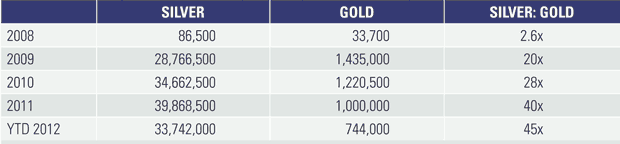
As you can see, investors are choosing to buy silver at a ratio to gold that is well above what is available. This uptrend doesn’t show any signs of slowing either. The ratio of the physical silver to gold is both rising and extraordinarily above the availability ratio of 3:1.
We can also use other data such as the most recent issues of the Sprott Physical Gold and Silver Trusts. The last Gold Trust issue in September 2012 raised US$393 million and the last Silver Trust issue raised US$310 million. On the basis of prices for each metal at the time of issue, we could purchase ~213 thousand ounces of gold and ~9.1 million ounces of silver. This represents a purchase ratio of 43:1.
If we examine ETF holdings in both gold and silver, we note that in the period from 2007 to 2012, the increase in silver holdings amounted to 12,000 tonnes, compared to 1,200 tonnes of gold – meaning, investors purchased ten times more silver than gold.
These are only three factual data points to consider, but there are other indications that silver investment demand is way out of line with availability. Our favourite question to the bullion dealers we meet, is to ask the ratio of their dollar sales in gold versus silver. The answer is that dollar sales are equal, which means that physical silver sales relative to gold are greater than 50:1.
A recent news headline on Mineweb read, “Silver Sales to Outshine Gold in India.2” It went on to quote a bullion dealer that “investors and jewelry lovers prefer silver jewelry these days.” As the largest importer of gold in the world, it would be impossible for India to purchase an equivalent amount of silver, as it would require more than one billion ounces, essentially more than the current annual mine production.
While these last two confirmations of silver demand are anecdotal, the statistics from the US Mint, the ETFs, and our Physical Trust issues, are factual.
For the time being, the silver price is essentially set in the paper market where the daily average trade on the Comex is approximately 300 million ounces. An outrageous number when you compare it to the daily mine production of about 2 million ounces. As Bart Chilton, Commissioner of the Commodity Futures Trading Commission stated on October 26, 2010, “I believe there have been repeated attempts to influence prices in silver markets. There have been fraudulent efforts to persuade and deviously control that price. Based on what I have been told and reviewed in publicly available documents, I believe violations to the Commodity Exchange Act have taken place in the silver market and any such violation of the law in this regard should be prosecuted.”3
Which brings us back to the phrase “Follow the money.” In our view, it is almost inconceivable that investors would allocate as many dollars to silver as they would to gold, but that is what the data shows.
The silver investment market is very small. While the dollar value of gold in the world approaches $9 trillion, the value of silver in the forms of jewelry, coins, bars and silverware is estimated at around $150 billion (5 billion ounces at $30 per ounce). This is a ratio of 60:1 in dollar terms.4
How long can investors continue to buy silver at the current ratios when the availability for investment is only 3:1? We are surprised that the price of silver has remained at such a depressed level compared to gold. Historically, the price ratio between gold and silver has been 16:1, when both were currencies. Today the ratio is 55:1, so what are the numbers telling us? We believe this is one of those times when smart investors will be well rewarded to “Follow the money.”
On behalf of all of us at Sprott, I wish you safe and happy Holidays and a prosperous New Year.
P.S. – US Mint Sold Out of Silver Eagle Bullion Coins Until January 7, 2013
The Mint recently informed authorized purchasers that all remaining inventories of 2012-dated Silver Eagle bullion coins had sold out and no additional coins would be struck. Since the 2013-dated coins will not be available to order until January 7, 2013, this leaves a three week void for the Mint’s most popular bullion offering.
About Sprott Asset Managment
Sprott Asset Management LP (Sprott AM) is the successor to Sprott Asset Management Inc. which was founded in 2000, after the permanent separation from Sprott Securities that established in 1981. After establishing Sprott Asset Management Inc. in December 2001 as a separate entity, Eric divested his entire ownership of Sprott Securities to its employees. Sprott AM is a fund company dedicated to achieving superior returns for its investors over the long term. In June 2009, Sprott AM reorganized to better define and streamline the key segments of our business. Sprott Asset Management LP currently manages a number of long/short equity strategies and mutual funds. Sprott Private Wealth LP (Sprott PW) provides advisory services to high net worth individuals. Sprott Inc. is the parent company of Sprott AM and Sprott PW.
| 1 | Sources: Gold data is from World Gold Council www.gold.org, and silver data is from Silver Institute, http://www.silverinstitute.org/site/supply-demand/ |
| 2 | Source: Mineweb.com |
| 3 | Source: Bloomberg: http://mobile.bloomberg.com/news/2010-10-26/silver-market-faced-fraudulent-efforts-to-control-price-chilton-says.html |
| 4 | Sources: Gold data is from World Gold Council, silver data is from United States Geological Survey (USGS) and Silver Institute. |
Where Has Objectivity Gone?
It was the best of times; it was the worst of times for the American public over the past month, as it was treated to two high-profile, but deeply conflicting, economic forecasts.
Despite declaring in 2008 that the age of cheap oil was over, the International Energy Agency (IEA) surprisingly announced last week that the United States would become the largest oil producer in the world by 2020. Hooray! This superlative declaration titillated US media organizations, who understand quite well that Americans love to secure a #1 ranking in just about any category (save for prison incarceration, divorce rates and obesity). As I explained to the Keiser Report, however, the IEA has done little more than produce an attention grabbing headline here. Simply ranking the “top oil producer” in 2020 may mean much less than the public currently understands.
This announcement has since led to the magical thinking that we can somehow take ownership of this future “extra oil” not eight years from now, but rather…. today. In other words, the additional 3 mbpd (million barrels per day) of crude oil and the 1 mbpd of NGL (natural gas liquids) that the IEA forecasts for 2020 have suddenly been booked into the “readily-available” column and are already being factored into US growth projections. That is premature, to say the very least.
In contrast to the IEA’s report was the grim outlook recently offered up by legendary investor Jeremy Grantham, of GMO in Boston. Mr. Grantham has been increasingly sounding the alarm on a future of significantly lower growth rates for some years now. It is rather obvious, as well, that Grantham has been methodically making his way through the reading list of resource scarcity scholarship over the past five years, taking in the views of everyone from Joseph Tainter to Jared Diamond. Combined with the available data, Mr. Grantham has come up with the rather unsurprising conclusion that the rate of future growth is set to be much lower than most anticipate. In Grantham’s view, there will be no return to normal growth as was enjoyed in the US in the post-war period (after 1945).
Reactions to Grantham were predictable. Has he lost his mind? And of course: Grantham goes Malthusian was another common refrain. Many of the media outlets covering Grantham’s letter, On the Road to Zero Growth (link to PDF here; free registration required at GMO website), also engaged in predictable reductio ad absurdum, claiming incorrectly that he was calling for the end of the world. Indeed, no such call by Grantham was made.
It leaves the rational observer wondering: Why is the media so breathless in its exultation of any optimistic forecast, no matter how poorly supported? And why does it vilify those who attempt to argue the other side?
Where has our objectivity gone?
Grantham’s Actual Message
It’s clear that very few understood what Grantham was really saying.
Moreover, many were mistaken that Grantham has adopted an ethos of negativity or that he has become ideological in his views. Quite the contrary. He is working with the same data observed by many hedge funds, international organizations, and academic research that shows that, as we entered the past decade, the extraction and production rates of many critical resources began to slow – and slow significantly.
Just to kick off this discussion, let’s start with the master commodity, oil:

In the ten years leading up to 2004, global crude oil supply grew at a compound annual growth rate (CAGR) of 1.71%. This rate of supply growth started during the strong economic phase during the 1990s, and only strengthened after the recession of 2000-2002 when countries like Russia came online with fresh oil supply.
…..read more HERE

-
I know Mike is a very solid investor and respect his opinions very much. So if he says pay attention to this or that - I will.
~ Dale G.
-
I've started managing my own investments so view Michael's site as a one-stop shop from which to get information and perspectives.
~ Dave E.
-
Michael offers easy reading, honest, common sense information that anyone can use in a practical manner.
~ der_al.
-
A sane voice in a scrambled investment world.
~ Ed R.
Inside Edge Pro Contributors

Greg Weldon

Josef Schachter

Tyler Bollhorn

Ryan Irvine

Paul Beattie

Martin Straith

Patrick Ceresna

Mark Leibovit

James Thorne

Victor Adair