Gold & Precious Metals
Dec 13, 2016
- Gold stocks and silver continue to exhibit substantial strength in the face of the decline in the price of gold. Is that strength hinting that a substantial rally will follow a Fed rate hike?
- For some further insight into the matter, please click here now. Double-click to enlarge this key dollar versus yen daily bars chart.
- The dollar has arrived at the major resistance zone of 116 – 125. The yen is the fiat world’s top risk-off currency, and gold is the ultimate risk-off asset.
- So, it’s very important for gold bugs to watch the price action of the dollar versus the yen. For a closer look at the action, please click here now. Double-click to enlarge this 10 minute bars chart.
- At about 3:30AM on Monday morning, the dollar reached 116, and sold off from a small head and shoulders top formation.
- To view the price action for gold in that same 3:30AM timeframe, please click here now. As the dollar recoiled against the yen, gold began to surge against the dollar.
- Whether 116 marks some kind of final high for the dollar is unknown, but there’s no question that just as gold was vulnerable in the $1320 area going into the US election, the US dollar is now equally vulnerable, going into the Fed meeting tomorrow.
- Please click here now. Double-click to enlarge this daily bars gold chart.
- There’s a bull wedge pattern in play. Both technically and fundamentally, there are some great similarities between the current timeframe and last year, in terms of a potential rate hike and a gold price rally that follows.
- Unfortunately, there are also some important differences. There are rumours that Chinese capital controls are coming, and the government is restricting gold imports.
- That restriction is raising the gold price in China, but to raise the global price Chinese citizen demand must be allowed to be fulfilled.
- Janet Yellen has clearly stated that she seeks a “high pressure economy”, which is an economy where inflation is allowed to run higher.
- If she forcefully reiterates that view this week, the dollar could fall hard against the yen, and against gold.
- Also, banks are incentivized by rate hikes to make more loans, and a rise in loan activity is needed to increase velocity of the money supply.
- Regardless, my suggestion to gold bugs is to cheer for a post Fed meeting rally in gold, but be open to the idea that nothing too exciting happens until Trump gets inaugurated in January.
- Trump’s protectionist agenda is highly inflationary, and his tax cuts would help move money away from government, where it has no real velocity.
- In the private economy and fractional reserve banking system, it would get substantial velocity.
- For more good news on inflation, please click here now. While the fiat call-in in India may be responsible for a lot of the latest surge in oil demand, there’s no question that oil demand in India is growing at a very rapid rate.
- On the supply side, Iran and Russia appear to be ready to put a ceiling on supply. Against the background of inflationary rate hikes and “Trumpflation”, oil is extremely well-supported now, and poised to move higher.
- Please click here now. Double-click to enlarge. Technically, oil also looks superb. There’s a bull flag in play. Oil appears set to burst upside from a sizable rectangle formation, with my target being the $63 area!
- Please click here now. Double-click to enlarge this GDX chart. As noted, gold stocks are showing phenomenal resiliency over the past month, in the face of what is roughly an $80 an ounce decline in the price of bullion!
- GDX is essentially unchanged in price, while gold gets hammered. In a deflationary environment centred on system risk, gold bullion dramatically outperforms gold stocks. In an inflationary setting, which appears to now be imminent, gold stocks absolutely destroy bullion, in terms of upside performance. GDX could trade as low as $18 before a major rally starts, but it’s starting to look like $20 is the floor.
- It’s quite possible, even likely, that Janet Yellen does not want to upset her new boss, Donald Trump. Trump wants inflation, and he likely knows the only “solution” to US government debt is serious inflation that helps debtors and damages creditors.
- Janet Yellen is likely to help Trump get that job done. Mainstream analysts are seriously underestimating the amount of inflationary pressure that Janet Yellen is willing to tolerate once Donald “The Golden Trumpster” Trump becomes America’s most powerful man, on inauguration day!
Thanks!
website: www.gracelandupdates.com
.
Risks, Disclaimers, Legal
Stewart Thomson is no longer an investment advisor. The information provided by Stewart and Graceland Updates is for general information purposes only. Before taking any action on any investment, it is imperative that you consult with multiple properly licensed, experienced and qualifed investment advisors and get numerous opinions before taking any action. Your minimum risk on any investment in the world is 100% loss of all your money. You may be taking or preparing to take leveraged positions in investments and not know it, exposing yourself to unlimited risks. This is highly concerning if you are an investor in any derivatives products. There is an approx $700 trillion OTC Derivatives Iceberg with a tiny portion written
Gold & Gold Stocks Setup for Post-Fed Rally
Posted by Jordan Roy-Byrne - The Daily Gold
on Monday, 12 December 2016 15:10
Gold and gold mining stocks have been very oversold but have struggled to rally. The sector looked to be starting a rebound until Friday’s decline which pushed Gold to a new low. However, positive divergences remain in place as gold stocks and Silver remain above their recent lows. While the Federal Reserve could say something hawkish next week, the setup continues to favor a rebound in the precious metals sector rather than an immediate decline to new lows.
The monthly chart of Gold is shown below. Gold closed last week at $1162/oz after trading as low as $1157/oz. The weekly chart (not shown) shows key support (and closes) at $1158-$1165/oz while the monthly chart shows support from $1142 to $1157/oz. That range marked key support or resistance from the end of 2014 through most of 2015. It is highly unlikely that Gold does not hold this level in its current oversold state. However, that does mean Gold could test as low as $1142/oz before rebounding.
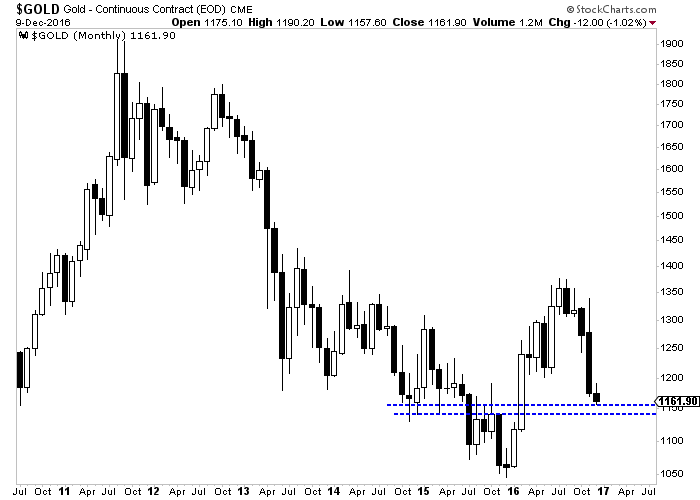
Gold Monthly Chart
The gold stocks are in a similar position in that they could drop a tiny bit more before the start of a rebound. The daily line chart below shows the strong support in GDX at $20, which includes the 400-day moving average. GDX closed Friday at $20.67. Also, the 62% retracement is 1% below $20, at $19.80. GDXJ has been stronger as it remains a good distance above its 400-day moving average and 62% retracement. However, the chart below shows key support at $32.50, which is 5% below Friday’s close.
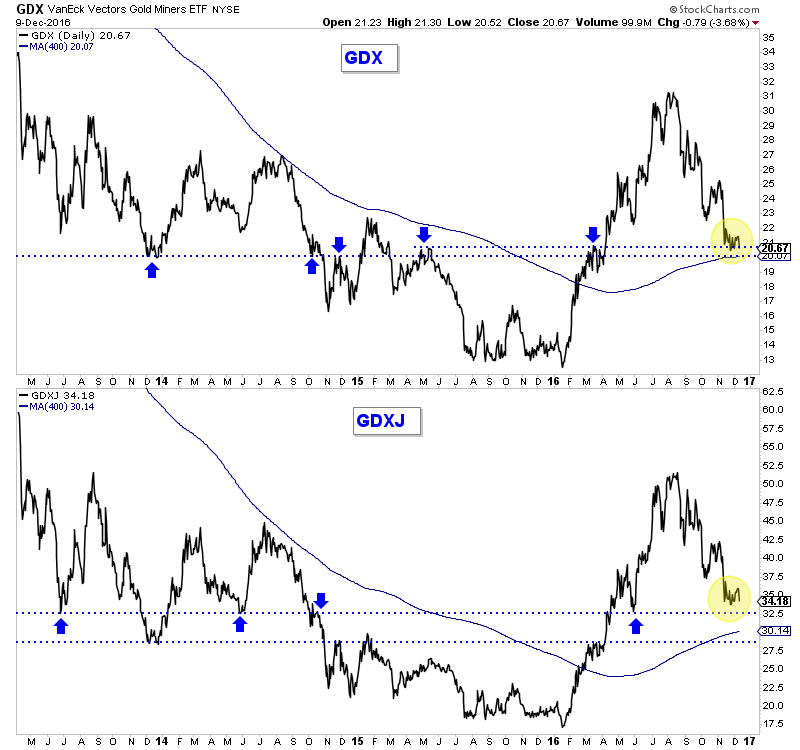
GDX, & GDXJ Daily Line
The technicals argue that both Gold and gold mining stocks could drop a tiny bit more before starting a rebound. It would not surprise me if the sector is soft into or even immediately after the coming Federal Reserve rate hike. Once that passes, the sector could be in position to rally as expected. The coming strength would be an opportunity for traders and investors to de-risk their portfolios and raise cash for a better buying opportunity early next year. Generally speaking, we do not want to buy investment positions until we see sub $1100 Gold and an extreme oversold condition coupled with bearish sentiment.
Jordan Roy-Byrne, CMT, MFTA
Jordan@TheDailyGold.com For premium service go HERE
…related: Next Bull Market Move: Rick Rule

This interview with Rick Rule in London touches on some incredibly valuable investment psychology points, as well as some insights into Rick’s plans at Sprott. ~ Catalin
We’re here in London in the Mines and Money Conference. I think it’s going to be a very interesting conversation we’re going to have. Recently, with the miners and gold and silver becoming very oversold in this correction, how do you think the play out will continue for over the next few years? Are we in a bull market?
I don’t mean to be fractious, but would dispute the fact that they’re oversold. I would suggest that they have been overbought in the summer. I would suggest that the correction that you’re seeing is normal and natural in a market like this. I believe in American parlance, and pardon me for doing that here, but in American parlance , we’re in the third inning of a nine inning ballgame with regard to the gold stocks. There is certainly renewed confidence in the system, and there’s also an age-old alternative to gold which is re-surging which is the US ten year treasury. At a 1.3% treasury yield, it was an unattractive instrument, but at 2% treasury yield, it’s a somewhat more attractive instrument, our elections notwithstanding.
Rick, how did you get involved in investing when you first started, particularly in the resource sector as well. How did you fall into that?
I have always been interested in business and always been interested in making money, at least as long as I’ve been cognizant. My early ambitions, my early university ambitions were to be a natural resource taxation lawyer. Don’t ask me how an eighteen year old set about to do that. I don’t actually remember, but that was my goal.
I was redirected by an early mentor, a very well-known tax lawyer away from law and into commerce. I had the extraordinary good fortune to meet a legendary value investor when I was still an undergrad in university. His name was Peter Cundill, and he’s legend among value investors. He was actually the one that set me on the course that became my career.
Fantastic. If you could go back in time and talk to a 30 or 20 year old Rick Rule, what would you advise him about money habits, investing, career guidance, things like that?
Really three things I guess in reverse order: Career guidance. Follow your passion. Do something that you can’t wait to get out of bed in the morning to do and you sort of resent having to go home at night from. If you are passionate about something, you will work easily. You’ll work longer, and you’ll create utility for other people without really being cognizant of what you’re doing. In other words, it won’t be work. It’ll be a calling.
If it is your calling and you are competing with people for whom it is not their calling, they won’t stand a chance. With regards to making money, you make money by adding utility for other people. It’s a fairly simple circumstance, actually. If you create value, you get to keep some of it. If you want to be rich, then in addition to you working, your capital has to work. In order to be a capitalist, you have to have capital, which means you have to save or in economic terms, you have to produce more utility than you consume.
You really do find that savings and investing become cumulative and compounding, meaning that the accretion of wealth when you’re younger is slow, but it becomes rapid if you continue to be disciplined and continue to work hard. What I’m tempted to say is at an alarming rate. It really surprises you later in life.
Can I ask about the psychology behind investing? It seems to me that most investors, most successful investors, don’t necessarily want to get rich just for the money, they’re more interested in researching the market, hunting for new investment opportunities, and then as a byproduct, the money is secondary. Would you agree with this?
Absolutely. Now, there are many different styles of investing, and I’m not suggesting that any of them were unsuitable. There’s only one style that’s suitable to me, which is the very empirical value-oriented style. There are many other styles that work. I certainly know investors who set out to become rich because they wanted the rich lifestyle.
For me, that’s less of a motivation. Certainly I didn’t want to be poor, and I don’t want to sound crass, but if I’m out with really good friends and I’m more fortunate than them, I don’t want them to have to look at the right side of the menu where the prices are, but that isn’t my primary goal. My primary goal is to have the capital to continue to be a capitalist. Many people have passions in life. Maybe it’s backgammon or maybe it’s museums. I just happen to be fortunate enough that people like to pay me well for my passion.
What would you say is the biggest lesson that the market has taught you in your career?
I’m limited really, for the most part, to natural resources. The biggest lesson with regards to resources is that they’re extremely cyclical. Bear markets are the authors of bull markets. Bull markets are the authors of bear markets, and the slogan that I use to educate my investors as quickly as I can to the market that they inhabit with me is that you are either a contrarian, or you will be a victim.
When things feel the worst, they’re the best, and when things feel the best, they’re treacherous. This lesson was an example of that. This summer was absolutely euphoric. The consequence of that is that most of the hardworking portfolios at Sprott were frozen out of the financing market because the turns were too buoyant and ebullient. The people who let their emotions overrun them in the middle of this year have been rewarded with a 35 or 40% spanking. This feels to be altogether a more rational and more intelligent market. I guess that’s the primary lesson that one learns in resources.
I think the second lesson is that maybe not in a one month or two month burst, but the harder that you work, the more that you employ, the more good fortune smiles upon you. You get luckier, if you will, if you work harder, if you employ empirical processes. The third, I think, is that you have to be part of one or preferably more networks. You can’t do it all yourself. You have to have access to financial skills whether or not you possess them yourself.
You have to have access to technical skills, geology, engineering. You have to read very, very, very wide. You have to be made aware of things that are outside your own particular circle so that you spread the number of data points that you examine. I think it’s important to read a lot. Read voraciously.
Definitely. Speaking of things that feel bad at the moment, the uranium market. Spot prices have been declining quite dramatically recently. Contrarian investors would say that this is an even better opportunity for the juniors. The juniors I’ve looked at recently have gone from pounds or dollars in 2011, 2007, down to pennies or cents now. This must be a great opportunity for the brave, I would assume?
This is. I suspect that Sprott, at least my part of Sprott, will become very deeply invested in uraniums this year. The international energy agency suggests in US dollar terms that the industry needs about $60 a pound in incentive price to produce uranium. That includes cost of capital. You make the stuff for 60, and you sell it for 20. You lose $40 a pound. You can’t make that up on volume. The truth is that we have some very hard months ahead of us. When I say months, I mean 18 to 24.
If you’re going to position in size, you need to position in anticipation for a turn in the market. My suspicion is that the fall, winter of next year will be ideal timing. Sprott is commissioned on a very thorough going study as we speak to try and really understand the dynamics of the uranium market because we think most people don’t, even uranium players. In conjunction with that, we will review the sort of 22 to 25 juniors that we think have a chance of surviving the market and try and participate in capitalizing five or six of them where we believe in management strategies to position themselves for the rebound.
We recently participated in the recapitalization of an Australian junior, Deep Yellow, behind John Borshoff and the original Paladin team who we enjoyed almost farcical success in the last bull market. That’s as much a bet on the team and the concept as it is on the uranium price. My suspicion is that I’ll be at least 18 months early with my Deep Yellow investment, but the truth is I was four years early with my Paladin investment, and that went from ten Australian cents to ten Australian dollars. Sometimes, being early is forgivable.
Yes. Yep. Speaking of management, would you consider management the most important part of investing in a resource company?
Depending on the company, the stage of the company. For a junior, certainly. Most of the early stage assets are just excuses to lose money. You would be tempted to call them liabilities rather than assets. In that case, you need to think of these companies like technology companies. You need to think of exploration in the context of research and development. It’s the team that’s all-important.
You bring up a really good point. It isn’t merely that the team that you’re backing has been successful or determined. It’s important that they’re successful, that their past successes are in tasks that are immediately related to their task at hand. Somebody who has been successful operating a goldmine in Archean terrain in French speaking Quebec may be less successful exploring for copper in tertiary volcanics in Spanish speaking Peru. It’s important that the resume suit the task at hand rather than merely being an attractive resume.
Okay, that’s great. In regards to uranium again, do you think we’ll have, when the bull market finally happens, do you think we’ll have like a two year spike, or will this bull market continue longer because of China and all the reactors being built?
I definitely think it’ll be a spike. I think that the memory of the last uranium bull market is still so fresh in so many people’s minds that the market will exhaust itself in fairly short order. There’s no shortage of uranium in the world. There is a shortage of uranium that could be produced below 50 US dollars per pound.
Okay.
When you reduce sustaining capital investments in recovery uranium projects, your production begins to decline fairly quickly. That can be wrapped up. . My suspicion is that you’ll see sort of a two, two and a half year run in the equities that will take people’s heads off. You’ll see a longer sort of four year run in the commodity, but the market will get top heavy, I believe.
I once heard a quote from an investor saying that he didn’t want the Porsche, he wanted the ability to buy the Porsche. He just wanted the skills and the knowledge and the information and the research and that hard work that goes into purchasing a Porsche. Would you agree with this?
Yeah, completely. I would go a little further. It’s not my business what other people do with their money. I think ostentatious displays of wealth are unseemly, but that’s just as I say, it’s none of my business what other people do with their money. I have other things to do with my money. Public display, I suspect, in the social climate that we’re heading into, public displays of wealth will become dangerous as opposed to merely unseemly. I have no interest in touring around London in a Maserati or a Porsche. I prefer a Black Cab.
Yes. Most wealthy people I know of are exactly the same, and I think in my opinion that’s the reason why they’re wealthy. Okay. Final question about Sprott,what’s the future for Sprott Holdings and what’s going on in the next few years?
I’m not sure you have capacity in your recorder (laughs).
I’ll try (laughs).
Sprott is a very hardworking amalgam of people who are primarily focused on precious metals. We manage about two and a half billion dollars in credit and general equities outside the resource space, but mostly we’re a natural resource funding manager. On the retail side, I would suspect that by now we have the best brand name in natural resource small and micro caps in the world. Our goal will be to continue to build and capitalize in that brand in a bull market.
We have great experience in natural resource lending. We have great experience in natural resource private equity, my business. We have a Canadian mutual fund business, and we have a US precious metals trust and ETF business. Right now, all of those businesses are firing on all cylinders. We’re about something at Sprott. Our message is that while we believe that the ascent of man will continue unbroken, readjustments will be due in society due to excessive levels of debt, and due to an inter-generational transfer of wealth from your generation to mine. We have made promises that we intend to leave you the bill for.
At Sprott, our belief is that there will be some wrenching adjustments that need to be made. There’s a lot of euphoria in the United States, as an example, about our incoming president’s intention to spend a trillion dollars that we don’t have on infrastructure. There’s also a lot of euphoria about an impending tax cut, and by the way, I think tax cuts are a great thing because I think government is a bad thing. The truth is that nobody’s paying attention to the fact that in the US, our on balance sheet liabilities at the national level are about twenty trillion dollars.
The number is so large that people lose sight of it, and the truth is that the popular discussions in the press have more to do with, as an example, Trump’s hairdo or his fondness for female genitalia than they do with the debt and the deficit. My suspicion is that that’ll come back to haunt us. At Sprott, by contrast, we have about 300 million dollars in working capital and no debt. We try to eat our own cooking. In other words, we’d like Sprott to stand for something as well as being something.
We think we’ve done a good job of that. We’ve steadily built the business for five years in the bear market where many of our competitors were in fetal position. We anticipate that if it’s a huge bull market, they’ll be trying to be where we are now, but we won’t be there anymore.
Yeah, of course. Thank you very much Rick. That was really great. Hopefully we can do this when you’re in London again.
I look forward to it.
Thank you very much.
Euro Devaluation Accelerates – Millions Of Europeans Wishing They’d Bought Gold
Posted by John Rubino - DollarCollapse.com
on Friday, 9 December 2016 9:46
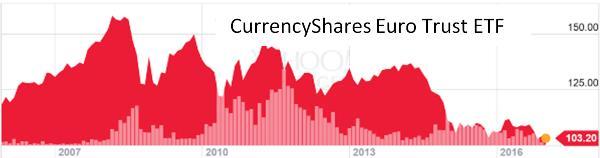
ECB Chairman Mario Draghi’s announcement of bigger and better QE this morning should have surprised no one. The fact is that the eurozone is coming apart at the seams and the only tool left to delay the inevitable is easier money. As the following chart illustrates, the euro has been declining since 2008, with the descent accelerating lately.
And more is coming. The only way for Italy, Greece and possibly France to keep it together is for their currency to plunge relative to those of their trading partners, thus making it easier to sell domestically-produced stuff abroad. So euro parity with the dollar will generate headlines when it happens but will just be a way-point on a journey to much lower numbers. That is, if the whole global financial system doesn’t blow up first.
What’s a European saver to do? Sitting on a euro-denominated bank account generated a 30% loss of real purchasing power during this “recovery,” which for the average European more than offset the trade benefits of a cheaper currency (hence the recent political turmoil). So going forward, cash is clearly not an attractive way to preserve capital.
Gold, on the other hand, is made for this kind of situation. In the past decade it has more-or-less doubled in euro terms. The difference between a 30% loss and a 100% gain is not lost on the people living through it, so expect European gold demand to rise going forward.
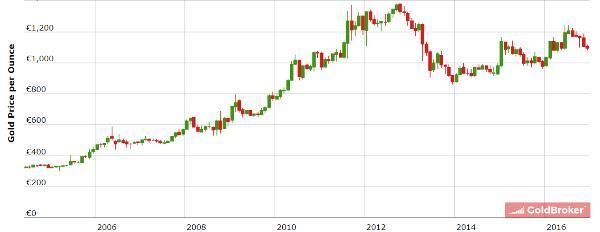
Meanwhile, the same thing is happening in China, where the yuan has been falling steadily and is now at a multi-year low to the USD.
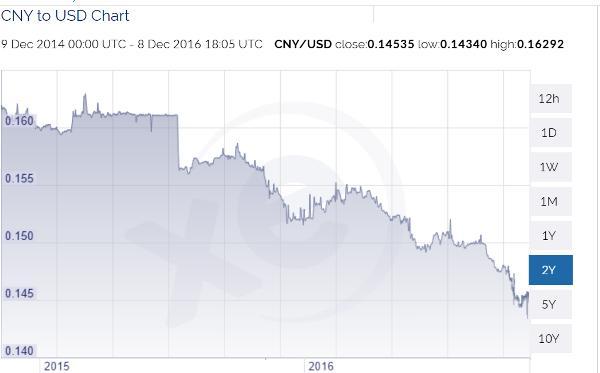
The difference is that many Chinese seemed to have understood what was coming and have for the past decade been loading up on gold. The result: currency devaluation actually improves the finances of large numbers of gold-owning citizens.
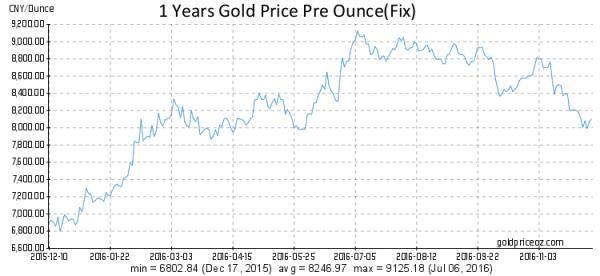

For Americans there are two lessons here:
1) Because we’re making the same mistakes as Europe and China – borrowing more than we can ever hope to pay off and papering the growing mess over with artificially-low interest rates and aggressive currency creation – the dollar won’t last long as the only major currency that’s appreciating. We’ll eventually be forced to devalue, which will take the currency war to a new and vastly more dangerous stage.
2) When the above happens gold will soar in dollar terms just as it is now rising in euro and yuan terms. So today’s US savers have a choice of role models: Will we be impoverished Europeans with shrinking bank accounts or enriched Chinese with ever-more-valuable stacks of gold?
….related: Euro swings to steep decline as ECB’s Draghi holds news conference
New Sharia Gold Standard Won’t Ignite Bull Market …
Posted by Larry Edelson - Money & Markets
on Thursday, 8 December 2016 14:53
Don’t believe everything you hear and read about gold these days. It’s just not yet prime time for the precious yellow metal.
If it were — gold would have held my important cycle low point at $1,245 on October 5. It did not. If it were prime time for gold, it would have rallied when Trump was elected, due to the inflation expectations of many of his policies. It did not.
If it were ready for prime time, gold would have already rallied on the recent approval of a gold standard in Sharia, Islamic law. It did not.
And if gold were ready for prime time, miners would already be taking off to the upside again. They are not.
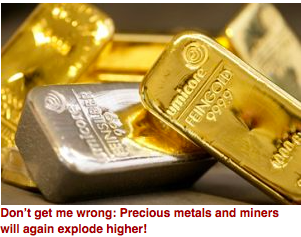
Don’t get me wrong: The time is edging ever closer when the precious metals and miners will again explode higher. It could be soon, or, it could be from below $1,000 gold in the first quarter of the new year that’s coming.
Either way, longer-term gold is heading to $5,000 an ounce, minimum, and most senior miners will at least triple while many junior miners will quintuple and more.
Silver, copper, platinum and palladium will all follow. But gold will experience the most stable gains. It’s more of a monetary metal than the others, though most governments are working hard to eliminate it as such.
The key is being patient and separating the wheat from the chaff. All markets have their time in the sun, and it’s the major macro-economic cycles that drive them.
Right now, the macro-cycles are still largely targeting the imploding sovereign debt markets in Europe, Japan and the U.S. That will continue for years.
In turn, it’s driving most money into either cash or mostly, a handful of the biggest U.S. blue chip stocks.
However, once the Dow Industrials and S&P 500 take their inevitable breather — coming soon — I strongly suspect we will see a big shift back into the precious metals.
Be patient and follow my lead. There’s oodles of money to be made in the precious metals and in the mining sector.
Stay tuned and best wishes,
Larry
…related: Gold Demand: Grand Slam For Islam

-
I know Mike is a very solid investor and respect his opinions very much. So if he says pay attention to this or that - I will.
~ Dale G.
-
I've started managing my own investments so view Michael's site as a one-stop shop from which to get information and perspectives.
~ Dave E.
-
Michael offers easy reading, honest, common sense information that anyone can use in a practical manner.
~ der_al.
-
A sane voice in a scrambled investment world.
~ Ed R.
Inside Edge Pro Contributors
Greg Weldon

Josef Schachter

Tyler Bollhorn

Ryan Irvine

Paul Beattie

Martin Straith

Patrick Ceresna
Mark Leibovit

James Thorne

Victor Adair