
Gold & Precious Metals

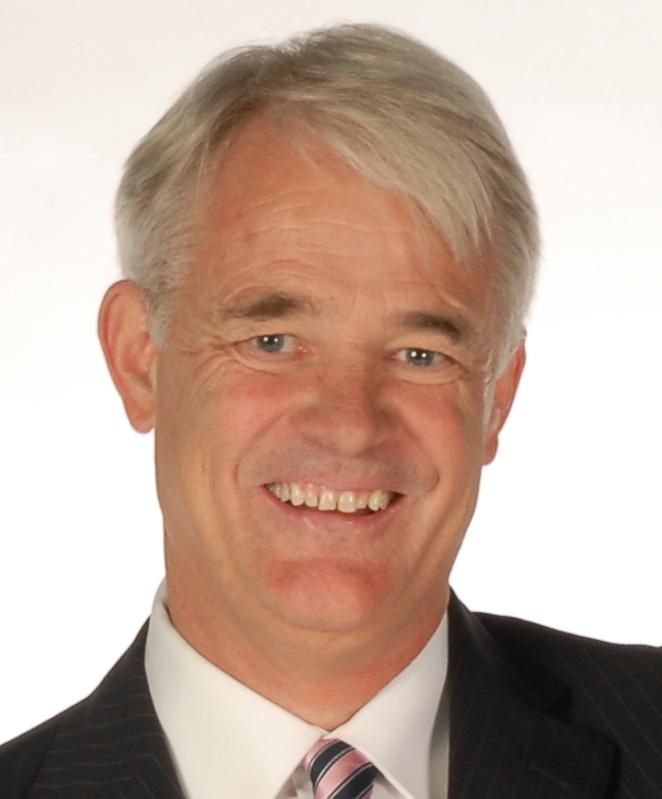
I Really Don’t Want To Do This But It Could Really Improve Your Investment Returns – Michael Campbell via Money Talks
…..continued:
I hate getting junk mail so let me start by saying that if you’re not interested in taking advantage of the most successful investment strategy I personally use then don’t read another word – and please forgive the interruption.
If you are still reading then let me help you decide if what I am about to tell you is of interest to you. I am talking about a method I use regularly to increase the rate of return in the “solid growth and income” section of my portfolio. For example – and this is NOT a recommendation – if you wanted to increase the income from owning the Bank of Montreal common shares ($57), which currently pay a 4.8% dividend to something in the order of 8% then all you would have to do is to sell call options. At today’s prices you could sell someone the right to buy the stock from you at $60 any day until December 21, 2012. If they decide to buy it from you your annualized return would be over 15%. If they don’t buy it form you your annualized rate of return is 9% – with an opportunity to raise it further by selling another call option.
Sound confusing? Well that’s why I have agreed to do a workshop on the selling of put and call options. I don’t want to do it. It’s going to take a lot of work putting together a program that people will not only be able to understand but will also be able to implement immediately. And let me be clear, I have no problem whatsoever if you don’t want to come. I am doing this workshop to fulfill one of my own goals of doing whatever I can to help people to improve their investment performance and secure their financial future.
It kills me to talk to people or read their emails and know that they are not taking advantage of the most effective method I know to improve their investment returns. I am not talking about a short-term homerun strategy. I am talking about pushing your return up from that 2, 3, 4% range to something above 10% and more with the use of a lower risk strategy. And one I might add that the investment industry does a very poor job of utilizing.
By the way, selling calls as I have described above is only one of the strategies I’m going to explain. The other main strategy deals with selling put options with the goal of acquiring quality stocks at 10% or more below the current market price. Let me give you another quick example. Let’s say you were interested in buying gold by using the gold ETF, GLD, but you’re worried it’s going to drop further. Yet at the same time you think that over time gold is going up and you don’t want to miss the move. One way I have solved that dilemma personally – and made a lot of money – is to sell a put, which means I have sold someone the right to sell me GLD at a specific price for a specific time.
For example, as I write this GLD is selling at $1600. Right now I can sell someone the right to sell me GLD at $1600 any day up until January 18th next year and I will receive $102 per ounce. In other words if he sells me the gold my cost will be $1498 – and if he doesn’t sell it to me (because he could sell gold for more in the open market), then I keep the $102 per ounce he paid me. And I can sell another put.
Again, confusing? Well that’s why I am doing the workshop. It is a workshop that deals with improving the yield on stocks you already own and paying less for stocks you want to own. My bet is that after you attend you will say, “why the hell didn’t someone tell me about this sooner.” In my opinion they should have but because way too many in the investment business don’t use these strategies I thought I’d better do something about it.
Don’t worry if you don’t have a clue about this stuff. The workshop is going to be split in two. I am going to start with a pre-workshop seminar to teach the basics of “put” and “call” options for people who aren’t familiar with options. We’ll take a break and then I’ll start with the main workshop detailing the strategies I personally use.
I want everyone to leave with a clear understanding and being able to immediately implement the strategies if they so chose.
Anyways, you can decide if this is for you. What I can tell you is that using puts and calls in the way I will be outlining has been my most effective strategy in this market for a number of years. I have done shockingly well with it.
I think it is ridiculous that in this market environment of extreme volatility and low interest rates that you don’t have every strategy available to help you succeed but that’s up to you. You can take a couple of hours to learn these strategies or not. I just wanted to do my job and make the information available. And I can honestly say, I can’t see myself doing this again.
I wish you all the best,
Michael Campbell
PS Originally High Performance Events were going to charge $295 – and to be honest I said that it was worth a heck of a lot more. I boasted to them that I could make that money back almost immediately but I also want to make it more affordable. So I ask them to see if they could get some sponsors to offset some of the costs. Plus we donate money to Special Olympics after every event I do.
So they went out and got Disnat, McLeod Williams, Kiska Metals and the Watermark at Sechelt on board, which enables us to offer the following ticket package.
Date: May 30 , 2012
Place: Sheraton Wall Centre Vancouver
Time: Per-Workshop Option Basics – 6:00 pm to 6:40 Options to Increase Your Investment Return Workshop 7:00 to 9:00 pm.
Price: $179 per ticket which includes :
• 3 free months free subscription to Money Talks exclusive Commentary Service that features a weekly comment from Michael plus exclusive contributions from Martin Armstrong, Mark Leibovit, Steve Briese, Bob Hoye, and Don Coxe.
• Unlimited access to the video recording of the event, which enables you to review everything at your leisure. This will retail for $119 but is included with the ticket.
• Plus we have arranged for follow-up seminars with Disnat further outlining how to use options. Complimentary for workshop attendees.
http://moneytalks.net/how-to-use-options-to-invest.html
Posted in All Posts by Peter Grandich.

“The most valuable commodity I know of is information.” (Gordon Gecko in “Wall Street” by Oliver Stone)
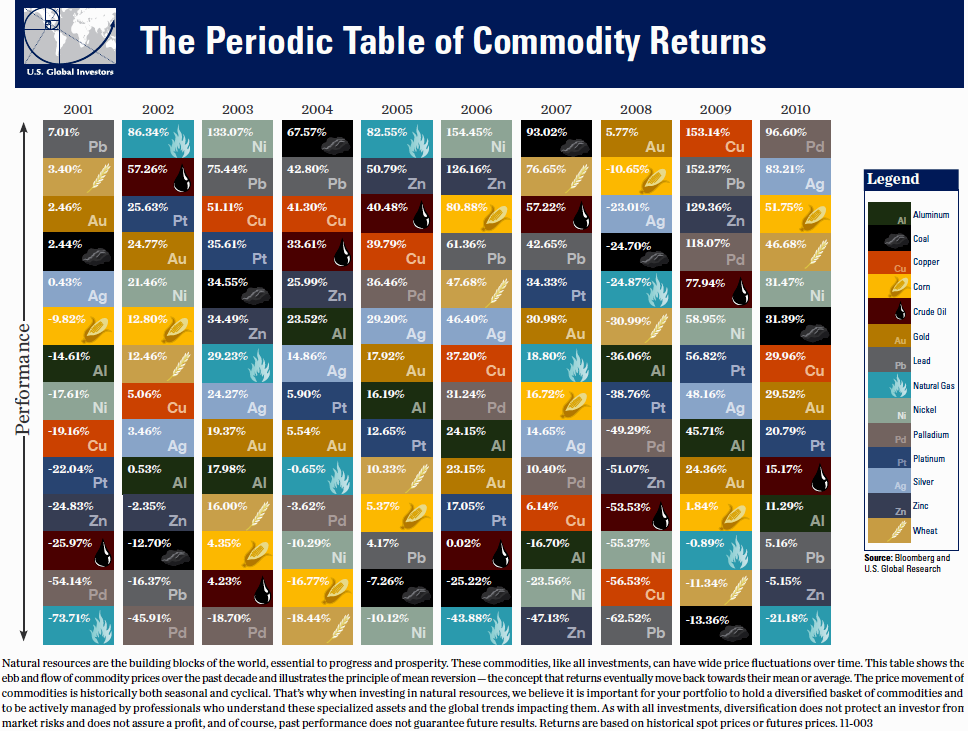
Commodities have experienced a renaissance after the bursting of the internet bubble at the end of the 20th century. The new and long-term upward trend began with most commodities in late 1990s and already lasts nearly 15 years. During this time, most commodity prices manifold strongly. The following table presents the maximum price increases of selected commodities since 1999:
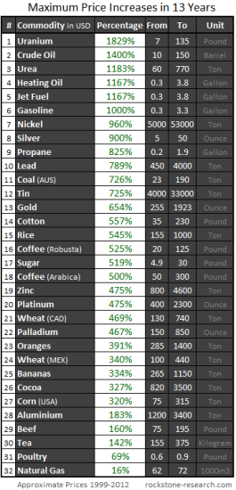
Indeed, these were all pretty formidable price increases (except of natural gas) – however, also frightening at the same time. Formidable of course for investors who diagnosed correctly and timely the start of the bull market in commodities now sitting on luscious profits potentially chilling the champagne now. Yet simultaneously frightening, because what if the boom has come to an end? Are those formidable profits on the verge of being vanished into thin air? Wouldn’t it be better to sell and realize profits?
Potential new investors face similar frightening questions: Getting in now? What if the all-time highs are already behind us? What if the bubble was punctured recently and is ready to burst now? What if the globalized world economies are standing on somewhat healthy feet again after the successfully passed finance, euro and Greece crises? Shouldn’t one buy when the blood flows ankle-high and sell when the corks are popping? Is the stuff with the blood already behind us or still in front of us?
Furthermore, a highly used argument against commodities is that they can bring extreme profits solely thanks to an increased volatility that is driven by short-sighted speculators, hedge funds and other kinds of grasshoppers. An increased volatility – per definition a large price range – is also valued negatively as being unpredictable like the tempers of a diva. And when comparing with other “classical investments”, the risk-reward ratio is said to be not as prettily balanced as with bonds, stocks or fixed-income securities.
However, the Yale University calculated and empirically prove that in the long run, commodities yield an average profit of 11% per year, which is about the same as for stocks. Yet the risk is significantly lower with commodities than with stocks. This study was completed in 2004, thus at a time when the commodity boom just started and the real strong price increases were to follow.
To Read More CLICK HERE
When given the opportunity to expand on his thoughts, Marc Faber, of the Gloom, Boom, & Doom Report, provides dismally clarifying detail on the state of the world. In this excellent (must-watch on a day when nothing changed but European stocks dead-cat-bounced) Bloomberg TV interview, the admittedly ursine Faber reflects on the US (slowing of revenue growth and the real linkages to European stress) noting that unless we get a huge QE3, there will be “a crash, like in 1987” noting he believes we have seen the highs for the year; on the likelihood of QE3 (agreeing with us that the Fed won’t act unless asset markets plunge first); on Greece’s exit of the Euro and whether policy-makers can manage the exit properly “bureaucrats in Brussels and the media are brainwashing everybody that if Greece exited the euro, it would be a disaster. My view is the best would be to dissolve the whole euro zone”; on the difference between investment markets and economic reality (thanks to financial repression); and on the global race-to-debase “I do not have a high opinion of the U.S. government, but the bureaucrats in Brussels make the government in the U.S. look like an organization consisting of geniuses. The bureaucrats in Brussels are completely useless functionaries”.
To Watch the Video or Read More CLICK HERE

On April 17 I wrote about a conversation with an individual who lives in Athens. He had this to say about the coming Greek elections:
“The other parties are communists, radicals and crazies. If they have a hand in the new government, then on May 7 Greece will be forced to take dramatic steps. The whole idea that the country should suffer, so the bankers can get paid will have to change.”
He also said this:
“The attitude in Brussels and Bonn towards Athens will change after the election as well!”
He had that right, so I called him back to get an post-election update.
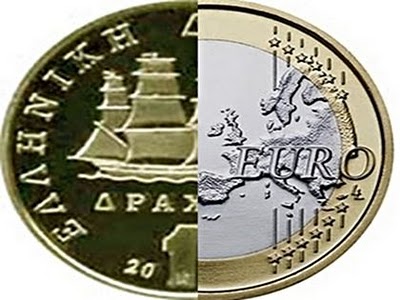
BK: Is it true that you will soon spending Drachmas?
Athens: This seems to be the only possible outcome. Germany will no longer support Greece, neither will the IMF.
BK: What would the new Drachma be worth in Euros?
Athens: Far less than the rate that was used to convert Drachma to Euros in 2001. At least 50% less. For Greece, the exchange rate for the Euro will be the key, but you can’t forget that the Drachma will also have a new exchange rate for the dollar.
+
Greece joined the Euro in 2001 at a fixed conversion of 341Greek Drachmas to the Euro (EURGDR). In the period preceding the link, the USDGDR was 328.
Assume the Drachma floats freely and promptly loses half of its value versus the Euro. The market rate would be EURGDR 682. If the EURUSD was trading at 1.3000 it would mean that the USDGDR would be 568. The GDR would lose half its value against the Euro but it would only lose on 37% versus the dollar. I asked the fellow from Athens about this:
Athens: There is the proof. The Euro is too high against the dollar.
I thought that was an interesting comment. I went back and looked at the original conversion rates to the Euro for France, Italy and Spain and compared them to what the USD exchange rates would be today:
To Read More CLICK HERE

-
I know Mike is a very solid investor and respect his opinions very much. So if he says pay attention to this or that - I will.
~ Dale G.
-
I've started managing my own investments so view Michael's site as a one-stop shop from which to get information and perspectives.
~ Dave E.
-
Michael offers easy reading, honest, common sense information that anyone can use in a practical manner.
~ der_al.
-
A sane voice in a scrambled investment world.
~ Ed R.
Inside Edge Pro Contributors
Greg Weldon

Josef Schachter
Tyler Bollhorn

Ryan Irvine
Paul Beattie

Martin Straith

Patrick Ceresna

Mark Leibovit

James Thorne

Victor Adair